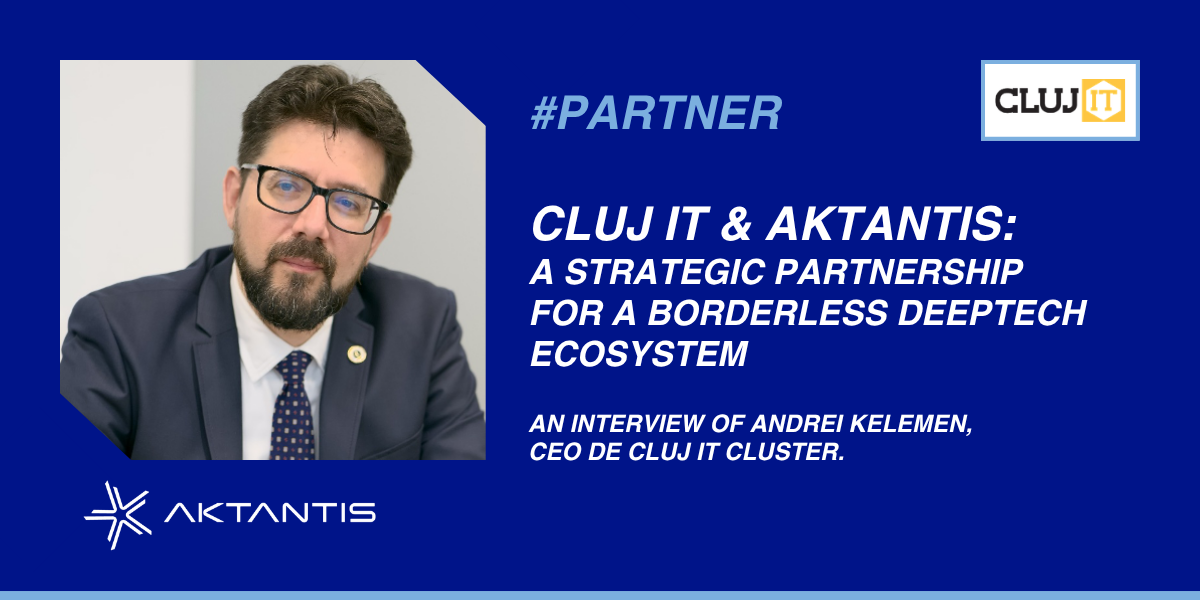
We meet Andrei Kelemen, CEO of the Cluj IT Cluster, based in Romania. Together with AKTANTIS, the Cluj IT Cluster is laying the foundations for enhanced cross-border innovation, based on the sharing of expertise. This dynamic generates tangible benefits for our members, with a clear ambition: to boost international competitiveness through innovation, collaboration and the development of high-value-added digital solutions.
Could you describe ClujIT (mission, areas of expertise, partners & ecosystem, types of actions)?
Andrei Kelemen: Cluj IT is the largest innovation ecosystem in Romania within the IT industry value chain, bringing together a diverse and well-structured community of over 100 members. This includes more than 60 software service and solution providers, 17 universities and research institutes, public authorities, and a range of catalyst organizations. What makes this ecosystem particularly strong is not just its size, but the way it integrates all key actors needed for innovation—from education and research to business and policy.
At the core of Cluj IT lies a clear mission: to increase the international competitiveness of its members through innovation, collaboration, and the development of high-value digital solutions. The cluster strongly promotes the idea that sustainable economic growth can only be achieved through close cooperation between the IT industry, academia, and public stakeholders. This philosophy is reflected in everything it does, from joint projects to long-term strategic partnerships.
In terms of areas of expertise, Cluj IT focuses on advanced digital technologies and innovation-driven domains. Through initiatives such as DIH4Society, it supports digital transformation in areas like artificial intelligence, data science, Industry 4.0, and cybersecurity. These capabilities enable both companies and public institutions to experiment, adopt, and scale new technologies in a structured and supported way.
What is particularly important is the ecosystem and partnerships that Cluj IT has built. It has successfully put Cluj on the European map of innovative digital hubs by fostering cross-sector collaboration and redefining traditional value chains. By connecting local actors with European networks and initiatives, it creates opportunities for internationalization, funding, and knowledge exchange, strengthening the region’s position in the broader digital economy.
Finally, when it comes to types of actions, Cluj IT acts as both an innovation enabler and a strategic facilitator. It supports digital transformation projects, provides services like digital maturity assessments and “test before invest,” facilitates research and development collaboration, and promotes technology transfer. At the same time, it plays an active role in building a sustainable and resilient ecosystem, where cybersecurity, innovation, and continuous learning are central priorities.
Overall, Cluj IT is more than just a cluster – it is a cohesive innovation platform that connects people, knowledge, and technology, helping transform Romania into a competitive and forward-looking digital hub on the European stage.
In what ways does ClujIT contribute to strengthening the competitiveness and innovation of companies in the Transylvania region among themselves and on the European stage?
Andrei Kelemen: If I were to summarize how Cluj IT Cluster strengthens competitiveness and innovation in Transylvania, I’d frame it around three main pillars.
First, Cluj IT acts as a collaborative innovation engine for the region. Instead of companies competing in isolation, the cluster creates an environment where businesses, universities, and public institutions work together. This collaboration leads to faster knowledge exchange, joint R&D initiatives, and the development of more complex, high-value digital products. As a result, companies don’t just grow individually—they evolve as part of a coordinated ecosystem, which significantly boosts their competitiveness both locally and across Europe.
Second, the cluster plays a critical role in accelerating digital transformation through initiatives like DIH4Society. Through this European Digital Innovation Hub, companies – especially SMEs – gain access to advanced technologies, testing environments, and funded support services. This includes areas such as AI, automation, and importantly, cybersecurity. By lowering the barriers to adopting cutting-edge technologies, Cluj IT ensures that even smaller firms can innovate at a level comparable to larger European players, helping the entire region keep pace with rapid technological change.
Third, Cluj IT strengthens the ecosystem by building trust, resilience, and international relevance, particularly through its focus on cybersecurity and global partnerships. Cybersecurity is not treated as a niche topic, but as a core component of digital competitiveness, helping companies develop secure products, comply with European standards, and build trust
with international clients. At the same time, the cluster actively connects its members to European networks and projects, increasing their visibility and access to new markets.
So overall, Cluj IT’s impact comes from combining collaboration, digital enablement through DIH4Society, and a strong emphasis on cybersecurity and internationalization. Together, these elements transform Transylvania from a regional IT hub into a competitive and innovation-driven player on the European stage.
Why did AKTANTIS and ClujIT come together? Why is it essential to build this type of collaboration?
Andrei Kelemen: AKTANTIS and Cluj IT Cluster came together out of a shared ambition to create stronger bridges between their communities and to unlock new collaboration opportunities for their members. Both ecosystems are deeply rooted in high-impact domains like AI & data analytics and cyber & digital security, so the partnership is a natural fit. By joining forces, they are enabling cross-border innovation, facilitating knowledge exchange, and opening wider access to European markets—ultimately generating clear, mutual value for companies on both sides.
This type of collaboration is essential because today’s innovation challenges, especially in deeptech, cannot be solved in isolation. By aligning their strengths, AKTANTIS and Cluj IT create a more competitive and connected ecosystem. Our focus areas strongly overlap especially in the context of DIH4Society and the EDIH OCCITANIA and Move2Digital, particularly in digital transformation.
What actions have we shared?
Andrei Kelemen: We built a strong connection with Aktantis in 2022 through the DREAM project. This relationship continues today through another Euroclusters initiative, CITADEL.
DREAM, now concluded, supported greener, more digital manufacturing by promoting digital technologies and stronger cooperation among SMEs across Europe. Our collaboration continues through CITADEL, a project dedicated to advancing Europe’s security ecosystem through green and digital transitions.
As part of the CITADEL project, Ms. Marielle Campanella joined our Executives Club event as a speaker and presented the project and its open call.
This partnership has grown steadily, and in 2025, Aktantis became a member of Cluj IT Cluster.
What is your vision for the future collaboration between ClujIT and AKTANTIS? What could our next joint initiatives be?
Andrei Kelemen: Looking ahead, the vision for this collaboration is to build a truly integrated European deeptech ecosystem—one where companies, especially SMEs and startups, can seamlessly collaborate, innovate, and scale across borders. AKTANTIS, as a European deeptech ecosystem, already demonstrates strong capacity in collaborative R&D and SME acceleration, which aligns closely with Cluj IT’s mission to boost the competitiveness of its members. Together, they can create a powerful platform for innovation, combining local strengths with European reach.
In terms of next steps, several joint initiatives stand out. These may include developing collaborative R&D projects that leverage existing funding opportunities, particularly those
supported by European programs. Both organizations are currently involved in initiatives like CITADEL which provides cascade funding opportunities for SMEs. Building on this and previous projects (such as DREAM), we could co-develop new proposals, facilitate matchmaking between companies and research partners, and expand access to funding instruments.
Additionally, future initiatives could focus on joint innovation services, knowledge-sharing events, and programs designed to connect startups and SMEs to international markets.
By continuing to align their ecosystems and co-create opportunities, AKTANTIS and Cluj IT are well positioned to drive meaningful, long-term impact in the European innovation landscape.
Your contact